

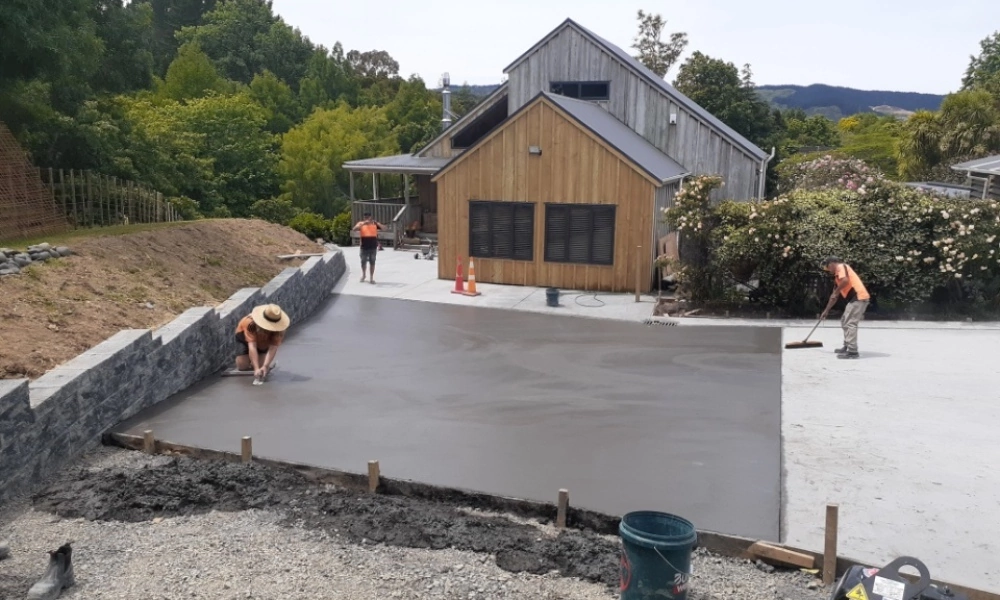
Water movement across a driveway surface determines how long that surface holds up and how well the surrounding property manages rainfall over time. Getting drainage right isn’t something that happens automatically when concrete gets poured. It requires deliberate planning from site assessment through to final grading. A concrete driveway contractor focusing early attention on runoff planning creates a driveway built for long-term performance.
Site assessment first
Before forming or pouring begins, experienced contractors read the existing water movement patterns across the property. Where does water travel during rainfall? Which directions does the natural grade push runoff? Are there low points where pooling already happens? Those observations shape every drainage decision that follows because working with existing site conditions produces better long-term outcomes than imposing a drainage design that fights the natural topography of the land. This assessment also considers soil type. Water stays near the surface longer on clay-heavy soil. The surrounding ground absorbs water more slowly when the clay content is high. This is rather than assuming rainfall dissipates quickly after leaving the driveway surface.
Slope and grade solutions
The primary drainage tool any contractor has is slope. By pitching away from the structure at the correct gradient, water drains away from the foundation without additional drainage infrastructure. It keeps water flowing without being too steep for vehicles or pedestrians using the surface every day.
Crown profiles offer an alternative for wider driveways where pitching the entire surface toward one side would create too steep a cross-slope. A crowned driveway rises slightly toward the center and falls away toward both edges, directing water to both sides simultaneously. Contractors select between edge-pitched and crowned profiles based on:
- Driveway width and how far water needs to travel before reaching a drainage edge
- Adjacent landscaping or structures limiting where runoff can safely discharge
- Existing drainage infrastructure on the property that connects to the driveway system
- Local requirements governing where driveway runoff legally discharges
- Foundation elevation relative to driveway grade at the garage connection point
Channel and inlet options
Some sites need active drainage infrastructure beyond surface slope alone. A trench drain located along the driveway directs water into underground pipes. These work well at the base of sloped driveways when water accumulates at the entry or pushes against it repeatedly. Low-level catch basins capture runoff that pools on the surface or against walls and foundations. They are sized based on the contributing drainage area and rainfall intensity. Undersized drainage infrastructure handles light rain while failing during the storms that actually put the system to the test.
Integrated drainage
The driveway drainage system is part of the property’s water management system. Contractors install driveway drainage systems that connect to downspouts, swales, and underground drainage. The driveway transfers water efficiently, but accumulates water elsewhere, creating problems. It’s just moved. A porous concrete slab addresses drainage differently by allowing water to pass through rather than across. This approach is suitable for properties where the total runoff volume matters more than how the water exits the driveway.